Direct Answer
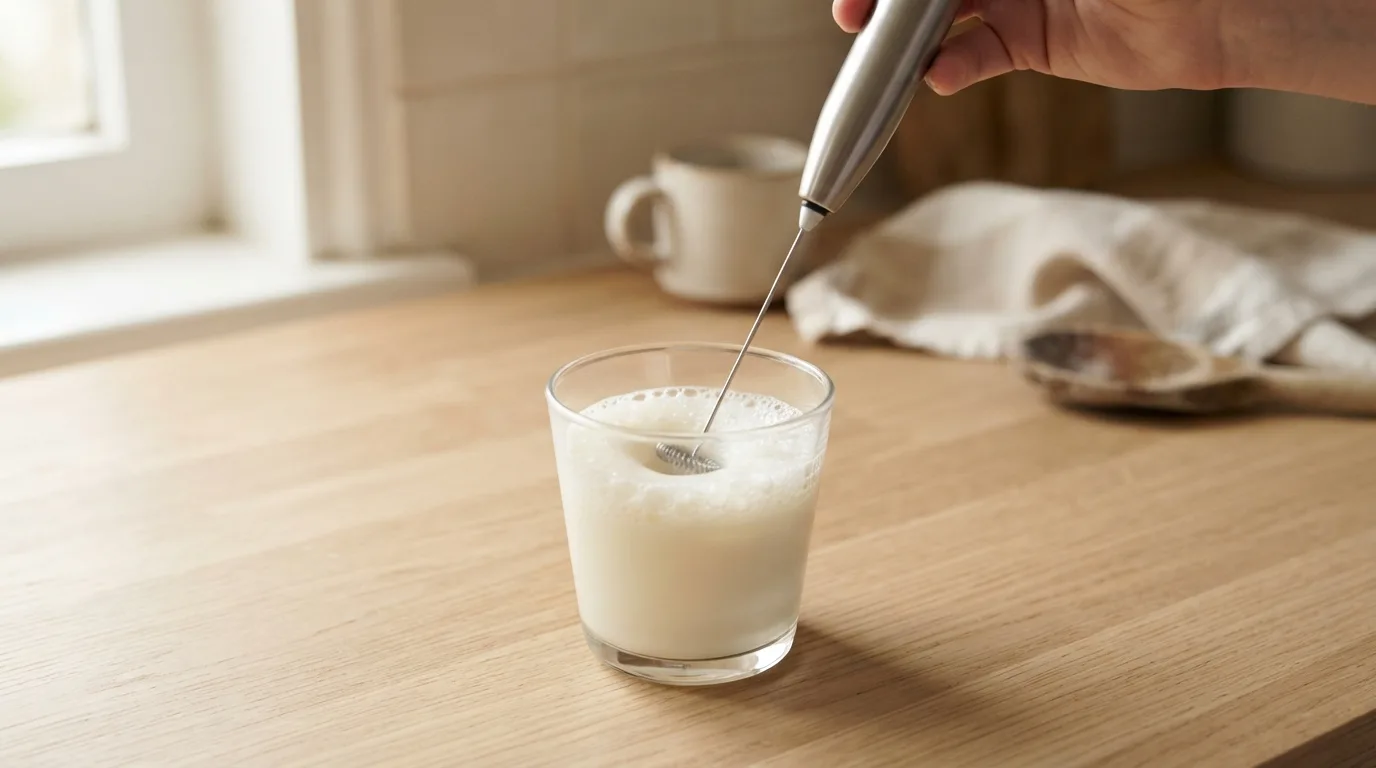
A handheld milk frother is a battery-powered whisk on a stick: a small motor, a shaft, and a coiled wire head. Submerge it just below the surface of your milk, run it for 30–60 seconds, and you have foam.
It is the cheapest type by a wide margin, the fastest for a single cup, and it lives in a drawer. What it does not do is heat anything — you warm the milk first, or you are making cold foam, which is a legitimate thing to want.
Why the Simplicity Is the Point
There is very little to a handheld wand, and that is most of its argument. Fewer parts, nothing to plug in, nothing occupying counter space, and one component to rinse.
It also gives you more control than an automatic frother does. Because you decide how deep the whisk sits and how long it runs, the same wand can produce loose foam for hot chocolate or the tight microfoam a latte wants. An electric frother's preset is more consistent but harder to push past. If you are learning to texture milk deliberately, the manual control is an advantage rather than a limitation.
What It Asks of You
You supply the heat. Twenty to thirty seconds in a microwave gets milk into the range where it foams well. This is the whole trade against an electric frother — one extra step, in exchange for a much smaller and cheaper device.
You supply the technique. Depth matters. Too deep and the whisk stirs without aerating; too shallow and it sprays milk across the counter. Just below the surface, moving slightly, is the position — and this is the single most common reason a new handheld seems not to work.
You supply a decent vessel. Something taller than it is wide, filled no more than a third. Foam needs headroom.
Two Things Worth Checking Before Buying
Does the whisk head detach? The motor housing cannot be submerged, so a fixed whisk means cleaning a wet coil attached to something you must keep dry. A detachable head is rinsed in seconds. This is the single biggest day-to-day difference between two otherwise identical wands.
Batteries or rechargeable? Rechargeable means nothing to buy and a USB cable to keep track of. Replaceable batteries mean the device outlives its own cell — a wand with a dead built-in battery is finished, while one that takes AAs is not. Neither is correct; they fail differently, and it is worth knowing which failure you would rather have.
Everything else on the box — speed settings, colours, a stand — is real but minor. A stand is genuinely convenient and genuinely not worth choosing a worse wand for.
Where It Falls Down
It does one cup. Frothing enough milk for two drinks means doing it twice, and by the second one the first has started to settle.
It also has a failure mode the other types do not: the shaft seal. Milk drawn up into the housing kills the motor, and it is why the "rinse the head, keep the body dry" habit matters more here than the instructions make it sound.
Who It Suits
Someone making one milk drink at a time who already owns a microwave and would rather not give up counter space. That is a large majority of people who want a frother, which is why this is the category most home kitchens should start in.
It is the wrong choice if you are making two lattes back to back every morning — that is what an electric frother with a base is genuinely better at — or if you want no motor at all. The three-way comparison is in handheld vs electric vs manual.
And if you are frothing milk a few times a month, a jar with a lid does this for nothing.